Class M7 / Smallest operational locomotive in Sri Lanka
Class M7
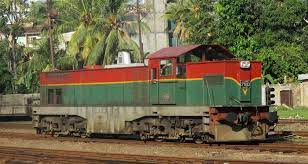
Class M7 is the smallest operational locomotive engine. But, this locomotive provides a huge service to Sri Lankan railways even though it's small in size.
Specifications
- Imported Year - 1981
- Manufacturer - Brush Traction
- Imported Number - 16 ( 799 - 814 )
- Imported Country - England
- Powered Type -
DIESEL - ELECTRIC - Powered Engine - EMD 8-645 E 2 stroke
- Maximum Power - 994 horsepower
- Maximum Speed - 80 kmph ( 49 miles per hour )
- Length - 12.8 m
- Axel Arrangement - BO'BO
- Weight - 66 tons

* As mentioned Class M7 is the smallest engine used for normal passenger trains in Sri Lanka. This
engine also has a very short length of 12.8 meters. Due to the short length of the engine it can take huge curves on the line very well.
*It also has a light weight when comparing with the other train engines. Class M7 isn't as powerful as other train engines as well.
Running Lines
These engines can travel on any railway line in Sri Lanka. But, It only travels on the Upcountry railway line if needed. It doesn't travel on the Upcountry railway line regularly because the "DYNAMIC BRAKES" of Class M7 don't function well on the Upcountry Railway line. But, It can travel up to Nawalapitiya without any issues. It travels up to Kandy and is regularly used on the Matale Railway line.
It can also travel on the Kelani Valley railway line but, isn't used for any passenger trains. It is used sometimes for sleeper trains ( Hauls track sleepers )
Trains Hauling
Class M7 hauls many short distance and office trains. It is also used for long distance trains ( Example :- Galle - Rambukkana mix ). It also hauls freight and ballast trains if needed. This engine mostly hauls slow trains.
Accidents Faced
Class M7 803 engine faced a major train accident on December 5th, 1999. The accident occurred between Rambukkana and Kadigamuwa stations, The accident took place when the night mail train was heading towards Colombo when the train with the M7-803 engine that came next hit the rear of the mail train at high speed. It was later revealed that this was due to the brakes not working on the M7). After that accident, the department decided not to run these M7 engines on the upcountry route because of the issue with the Dynamic Brakes.
Photographs of Class M7



Comments
Post a Comment